Giordano Bruno – the monad, number and figure
The philosopher burned in 1600 described the numbers from 1 to 10 as figures in a circle. Four points of agreement with the geometry of the tetractys.
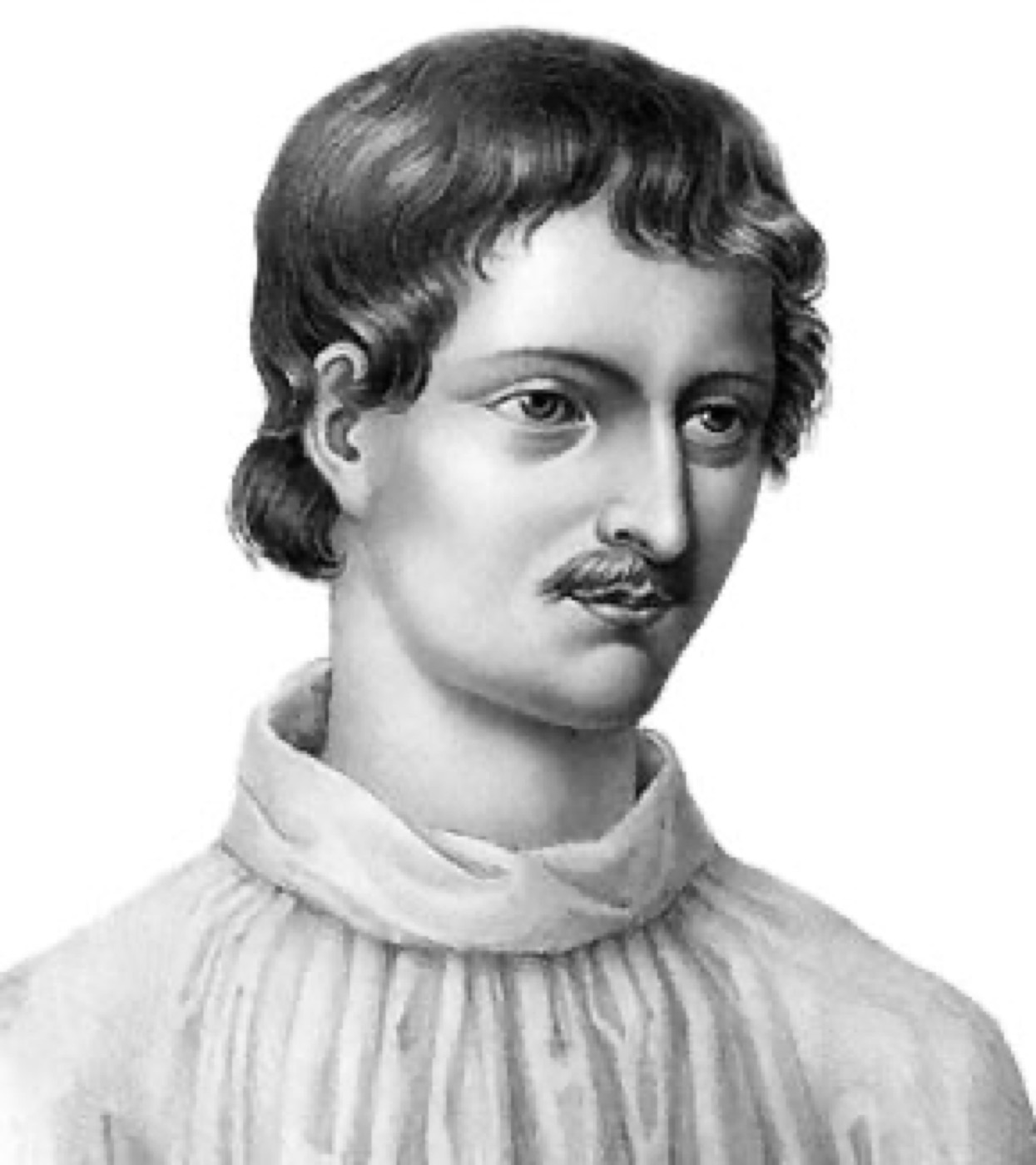
Giordano Bruno (1548–1600) was an Italian priest, poet and philosopher. The Inquisition found him guilty of heresy and magic, and he was burned at the stake in Rome. He held that space is infinite and the universe eternal. He rejected the Church’s geocentric world view as well as the Last Judgement. That sounds modern and scientific. In fact Bruno was never an atheist, and he was deeply engaged with magic and number mysticism.
De monade
This is shown above all by his work De monade, numero et figura, published in Frankfurt in 1591: On the Monad, Number and Figure as Elements of a Most Secret Physics, Mathematics and Metaphysics. In it Bruno describes the geometric, metaphysical and mystical character of the numbers from 1 to 10. He explains why he stops at ten with Neoplatonic reflections on fourness, that is, on the Pythagorean tetractys, though without a scientific approach. He also refers to the ten sephirot of the Kabbalah and to the ten fingers.
One can dismiss De monade as unscientific speculation or enjoy it as belles-lettres. But in four points Bruno agrees with the geometry of the tetractys:
- Natural numbers correspond to the symmetry of n-gons, that is, of simplexes.
- The geometry itself: polygon and simplex, fractal and sphere packing all appear in Bruno.
- The first ten numbers have a special meaning and are related to fourness.
- Pythagoreans and Neoplatonists said that number and the monad, unity, the circle with its centre, create the material world as its spiritual cause.
The figures
Among Bruno’s illustrations there are familiar forms:
- To consider the number nine, Bruno draws a nonagon with its connections, a 9-gon simplex, apparently inspired by the combinatorics of Ramon Llull.
- One figure shows a fractal pentagon, exactly the extension of the Sierpiński triangle to higher polygons described under Fractal polygons.
- For five he draws the pentagram, which because of its shape has always been associated with the human being.
- Another figure corresponds to the most important section of Kepler’s sphere packing: a tetrahedron seen from an edge.
A 9-gon simplex, as Bruno drew it to consider the number nine.
The fractal pentagon, one of the figures in De monade.
Open questions
The translator Martin Mulsow notes in the German edition (Meiner Verlag) that a reconstruction of Bruno’s geometric theories of the years 1586 to 1591 is lacking, as is a comparative study of his pictorial language. Every interpretation of De monade must therefore proceed cautiously.
Is De monade only a fragment of Bruno’s thought, so that on its own it is bound to be misjudged? Was it the philosophical-mystical side of a work whose scientific side once existed? That remains speculation. Connecting Bruno’s mystical images with the geometry of the circle remains a fascinating task, far from finished.