The tetractys in mysticism, Hermeticism and religion
Why a site that wants to give the tetractys a scientific basis deals with mysticism, and what the four elements have to do with it.
Why deal with mysticism when the subject is the scientific basis of the tetractys? Because the testimony of religion, mysticism and occultism can shed a good deal of light, if you read it with two questions in mind: What did the ancients know? And: Which of these old images agree with what can be shown geometrically and by calculation? There is no shortage of such parallels.
Circle and sphere
On this view the tetractys can only be understood through the geometry of circle and sphere. The circle has a mystical meaning in every culture. It stands for wholeness. With a point at its centre, for creation and the sun. Its symmetries around the centre, shown by regular polygons and star polygons, are as much at home in the Christian West, in Rosicrucianism, Freemasonry and the Kabbalah as in Eastern paths of initiation.
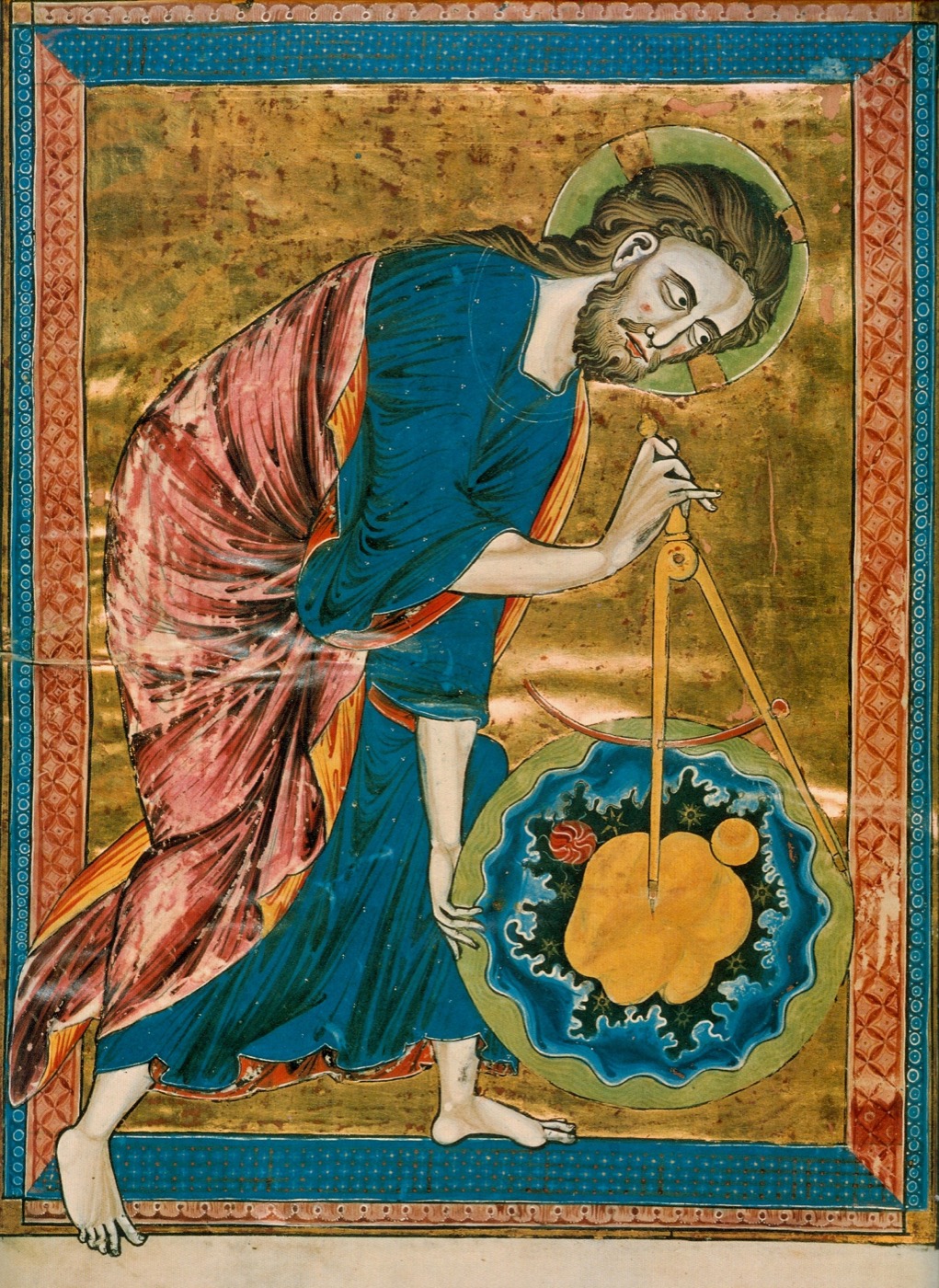
The sphere is perfect symmetry: every point on its surface has an opposite point, and it looks the same from every side. No other form encloses so much space with so little surface, which is why it protects its interior best. Light and all other forces spread spherically from a centre. Planets and suns are spheres, and the balance of forces is symmetry. Symmetry is also the overarching theme of particle physics, with differential geometry and Lie groups. Hermeticism, too, revolves around balance: above and below correspond, the four elements hold each other in equilibrium, opposites depend on each other. In the Kabbalistic tree of life, the middle pillar stands for this.
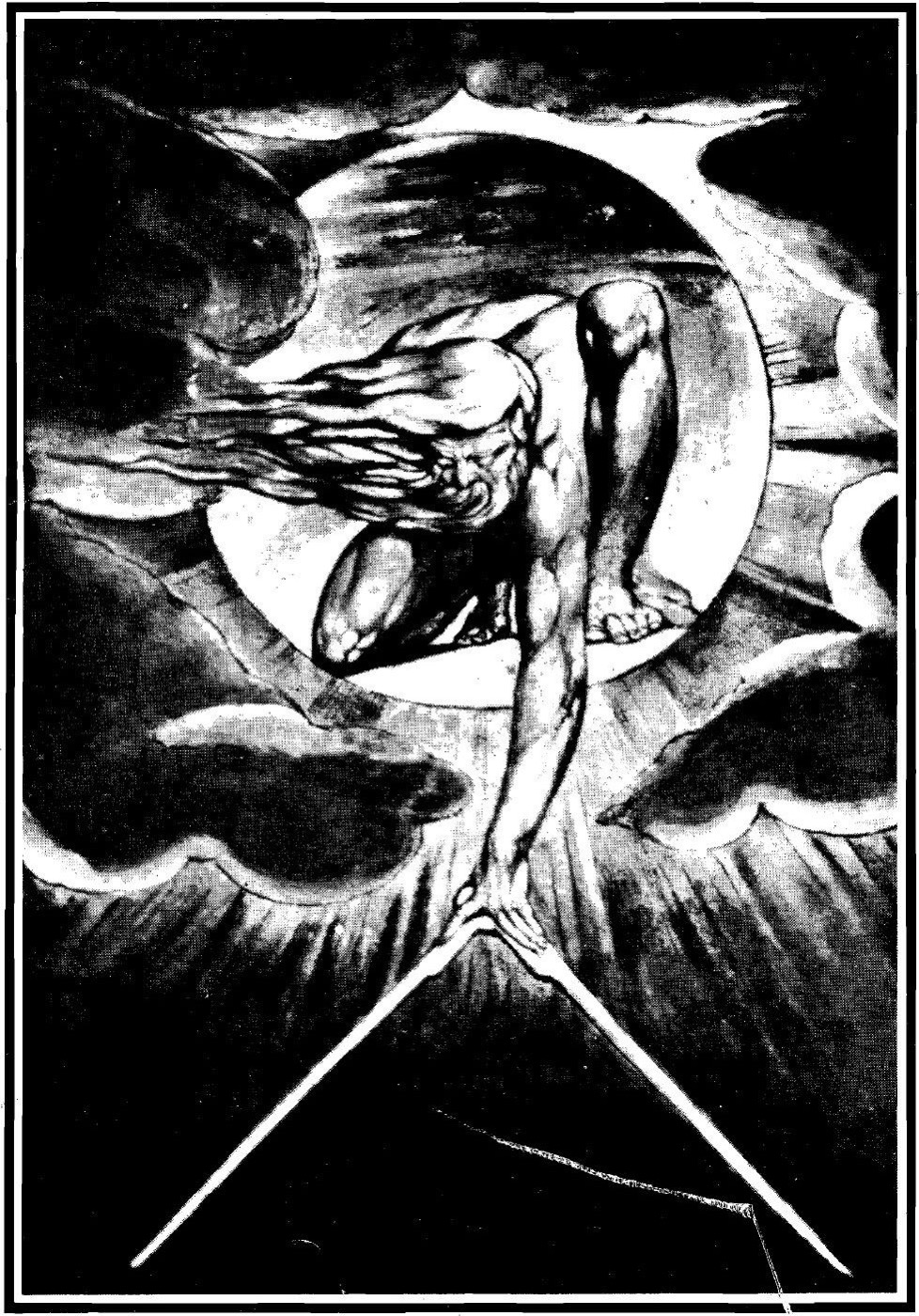
The four elements
Take the word tetractys, fourness, literally, and you come to one of the most important teachings of Hermeticism, the doctrine of the four elements: fire, air, water and earth. There are many interpretations of what is really meant by them. The best known assigns them to the four human temperaments, the “microcosm”:
| Element | Temperament | Basic attitude |
|---|---|---|
| Fire | choleric | willing |
| Air | sanguine | thinking |
| Water | melancholic | feeling |
| Earth | phlegmatic | being |
By the Hermetic principle of correspondence, the same forces must also be at work in the “macrocosm”. They can be read as the four great constants without which human existence would be unthinkable:
| Element | Fundamental quantity | Biblical figure |
|---|---|---|
| Fire | energy | lion |
| Air | time | eagle |
| Water | space | man |
| Earth | matter | ox |
Physics has four fundamental forces: the strong and weak interactions, electromagnetism and gravity. Describing them in a single theory is physics’ greatest unsolved problem. Hermeticism also knows four fundamental forces.
The four living creatures
In the Bible the four elements appear as the four winged creatures lion, ox, man and eagle that bear the throne of God: in the vision of Ezekiel and in the Revelation of John. Later they became the symbols of the four evangelists.
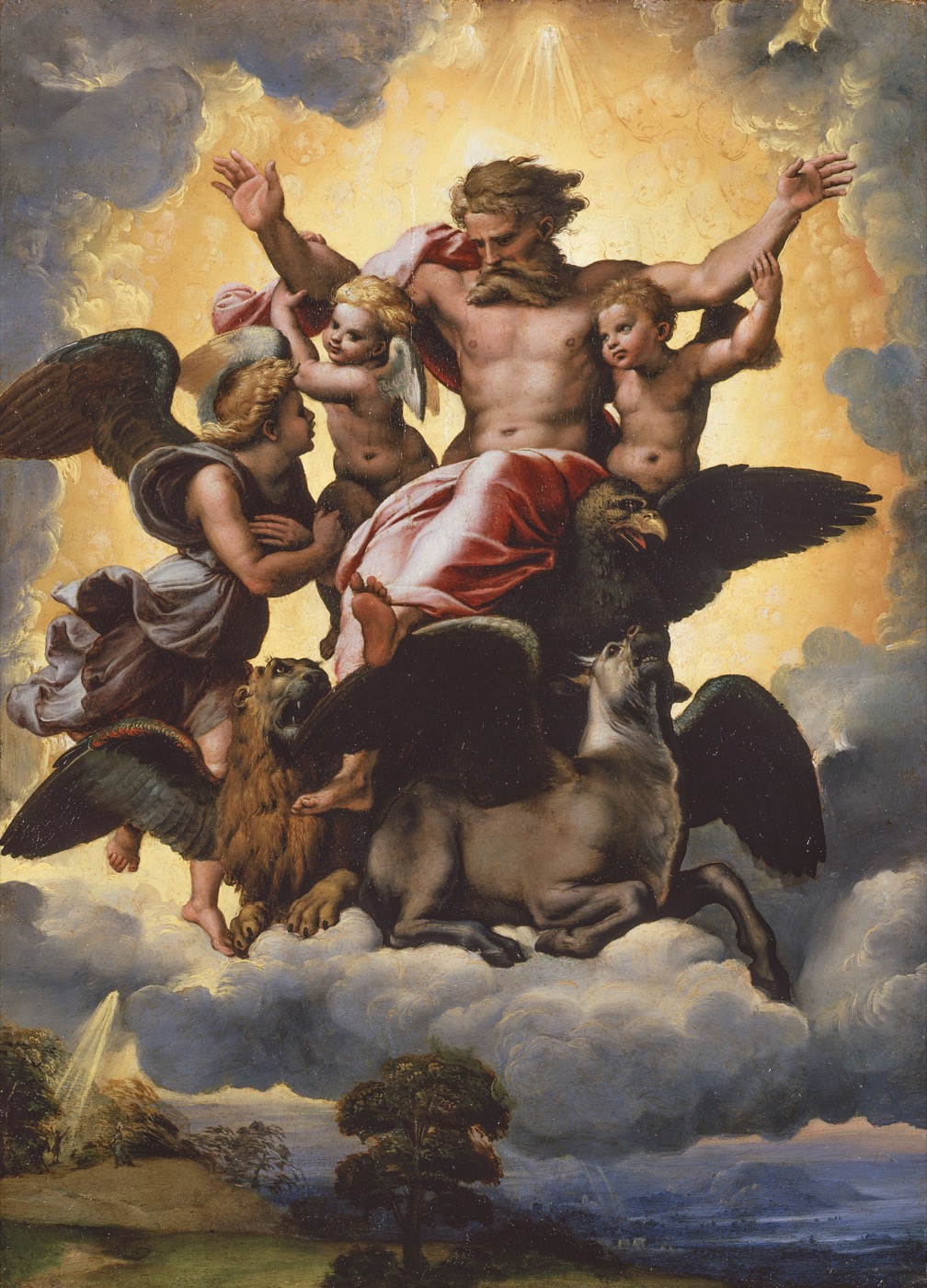
The meaning of these four creatures reaches far beyond the Bible. The tarot card The World shows them in its four corners. The fourfold structure of the tarot, and with it the four suits of playing cards, goes back on this reading to the same origin. Is the Bible, then, more scientific than one might think?
The figures
Triangle, square, pentagram and hexagram carry great symbolic weight in every Hermetic teaching. They are exactly the figures that are indispensable for understanding the tetractys:
The four start figures of the tetractys.
Everyday examples: the eye of God in a triangle on churches as a sign of the Trinity, the Star of David or hexagram over synagogues as a sign of the covenant between God and humanity, the pentagram as a protective amulet, which for centuries has represented the human being as “God in matter”.
How a rich order arises from a circle with a point at its centre is shown by the simplex. The first figures to appear are the triangle, square, pentagram and hexagram:
As the number of points grows, triangle, square, pentagram and hexagram emerge from the circle and its centre.
People reflected on the construction of such figures more than once in earlier centuries. The Catalan philosopher Ramon Llull (c. 1232–1316) developed in his Ars magna, the “great art”, a system meant to lead to knowledge through the mechanical combination of concepts on circular discs. Leibniz, the founder of mathematical logic, took up these ideas. Llull’s circles are strikingly similar to the simplexes.
The following pages pursue the question of what the ancients really knew.