Harmony of the spheres – star polygons in space
Connect the positions of two planets over years and symmetrical star figures appear. Venus and Earth draw a fivefold rosette.
That the universe is tuned like a musical instrument is one of humanity’s oldest ideas. According to legend, Pythagoras could hear the music of the spheres. Plato carried his discovery, that consonances correspond to simple ratios, over to the structure of the cosmos.
Kepler
At the beginning of the modern age Johannes Kepler gave this idea a new foundation. In his Harmony of the World (Harmonices Mundi, 1619) he tried to use the planetary laws he had discovered to show that the motions of the planets follow ratios corresponding to musical intervals. For him geometry, music and astronomy were at heart one, and what holds the world together were geometric archetypes, thoughts of God.
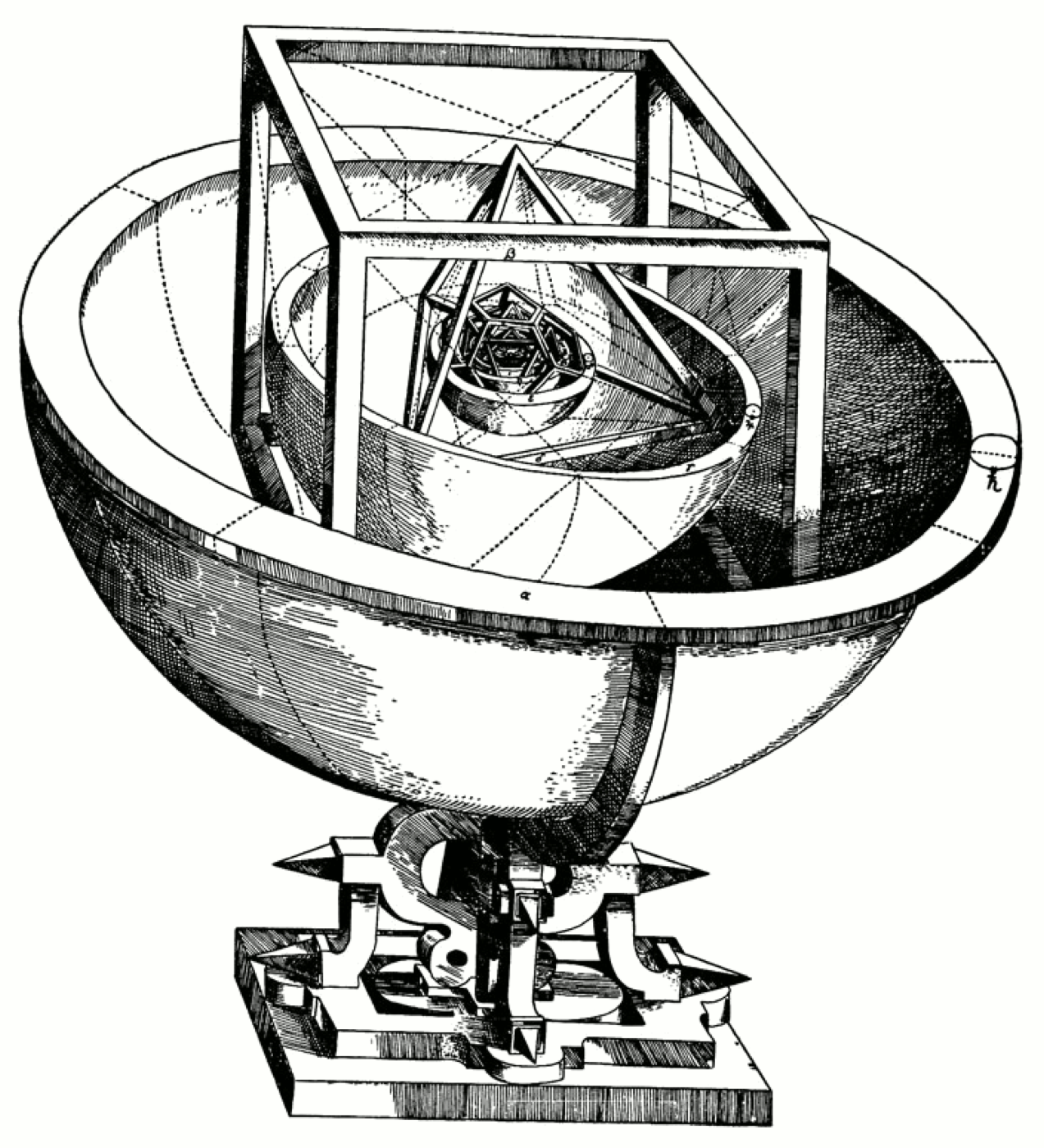
Earlier, Kepler had supposed that the distances of the six known planets were determined by the five Platonic solids, and later abandoned the theory. Why the five perfect solids fascinated him so much that he wanted to transfer them to the universe is answered by the geometry of gap-free filling of space. Long after Kepler, Schelling, Goethe, Hans Kayser, Hermann Hesse and many others were convinced these ideas held true. Today’s science, however, hardly takes the harmony of the spheres in the solar system seriously and calls Kepler’s ideas a beautiful dream.
Hartmut Warm
The engineer and programmer Hartmut Warm has revived Kepler’s idea in a new form. He studied not the distances between the orbits but the patterns of motion of pairs of planets over long periods. Connect the positions of two planets with a line at regular intervals and astonishingly symmetrical figures appear. In them Warm found geometric forms and, transferred to acoustics, intervals such as the third, fourth and fifth. His work is called Die Signatur der Sphären (The signature of the spheres).
Lines between two planets on simplified circular orbits, drawn over eight revolutions of the outer planet. Venus and Earth (the default) give a fivefold rosette, because 8 Earth years are almost exactly 13 Venus years.
The rosette of Venus and Earth is the best-known example: eight Earth years correspond almost exactly to thirteen orbits of Venus, and the five conjunctions in that time lie on the points of a pentagram. Whether these patterns are the harmony of the spheres of the Pythagoreans remains open. A direct link with the tetractys has not yet been demonstrated, but it is likely.