Pythagoras and the Pythagorean brotherhood
Man, teacher, priest, philosopher, politician, natural scientist and healer – what can be said about Pythagoras and what is legend.
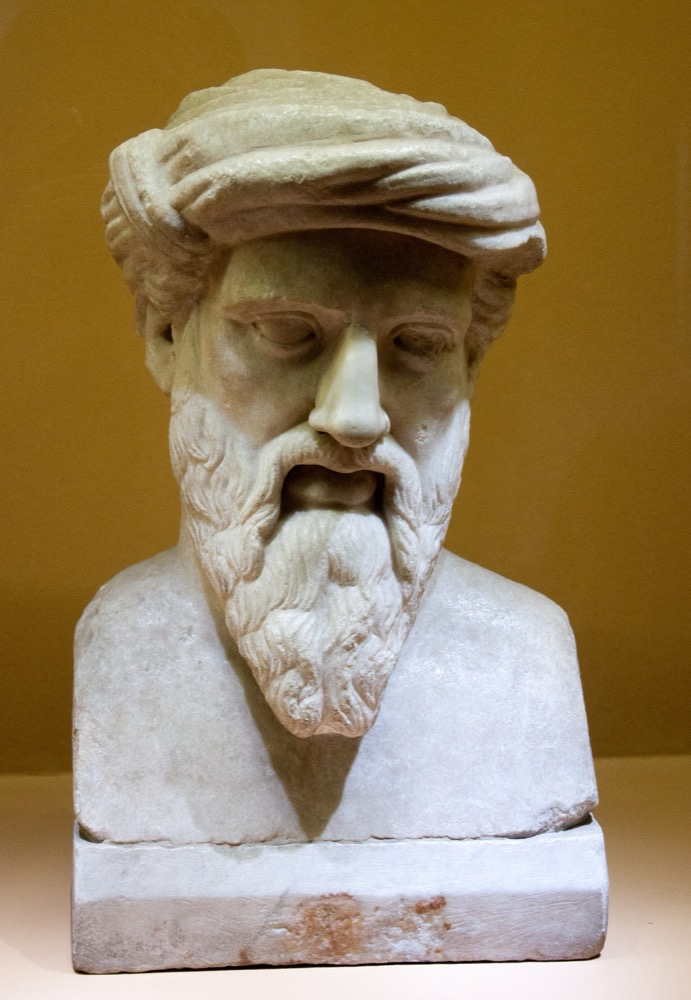
Hardly any thinker of antiquity is the subject of so many stories and so little certain knowledge. Pythagoras left nothing in writing. The detailed biographies by Diogenes Laërtius, Porphyry and Iamblichus were written seven to eight centuries after his death, and they mix tradition, veneration and tales of miracles.
The man
Pythagoras was born around 570 BC on the island of Samos, the son of a gem engraver or merchant. Among his teachers the sources name Pherecydes of Syros as well as Thales and Anaximander of Miletus. Later sources have him spend many years in Egypt and Babylon, learning mathematics, astronomy and priestly wisdom there. How much of this is true is unclear. It is plausible that he brought knowledge back from the East. The theorem of the right triangle, for example, was known in Babylon more than a thousand years earlier.
Around 530 he left Samos, probably because of the tyranny of Polycrates, and went to Croton in southern Italy. There he founded his community. He died after 510 BC, probably in Metapontum.
The teaching
At the centre stood the idea that the world is ordered by number and ratio. The harmony of tones, the course of the stars and the shape of bodies follow the same ratios. Added to this was a teaching about the soul: it is immortal and after death passes into new bodies, animals included. Life serves to purify it, through knowledge, music and a strict way of living.
The Pythagoreans distinguished between acusmatics, the “listeners” who followed rules and sayings, and mathematicians, the “learners” who were initiated into the reasons. This division explains why much of the circle’s knowledge remained secret.
The priest
In tradition Pythagoras appears as a holy figure: he was said to have a golden thigh, to work miraculous cures and to be able to appear in two places at once. His followers did not call him by name but spoke of “that man”. The rule of life included purity laws, white clothing, periods of silence for novices and curious prohibitions, such as the famous ban on eating beans.
The philosopher
The word philosophy, “love of wisdom”, is said to go back to Pythagoras. He did not call himself wise, the story goes, but one who loves wisdom. The principle “all is number” became the starting point of a line of thought that runs through Plato into the modern age.
The politician
The brotherhood was not a purely religious or scientific association. In Croton and other cities of southern Italy, Pythagoreans gained political influence. This provoked resistance: towards the end of the sixth century there was an uprising in which the meeting house in Croton was set on fire. Pythagoras fled to Metapontum. In the fifth century the communities were persecuted again and scattered.
The natural scientist
The name of Pythagoras is linked with:
- the discovery that intervals correspond to ratios (octave 1 : 2, fifth 2 : 3, fourth 3 : 4),
- the Pythagorean theorem and the idea of proof,
- the doctrine of figurate numbers (triangular, square and oblong numbers),
- knowledge of the regular solids and the construction of the pentagram,
- the idea of a harmony of the spheres, a music of the circling heavenly bodies,
- and, from his circle, the discovery of irrational magnitudes, which cannot be written as a ratio of whole numbers.
What goes back to him and what to later pupils can no longer be separated. The Pythagoreans traditionally credited their discoveries to the master.
The healer
The Pythagoreans regarded music as a remedy for body and soul. Tradition records melodies for the evening, meant to bring calm, and for the morning, meant to wake, as well as rules of diet and exercise. From the Pythagorean milieu came Alcmaeon of Croton, one of the first Greek physicians, who understood health as a balance of forces in the body.
The Pythagorean brotherhood
The brotherhood admitted men and women. Theano is named as an important Pythagorean woman. Members shared their property, lived by common rules and recognised one another by the pentagram. After the persecution the teaching lived on in smaller circles: with Philolaus, with Archytas of Tarentum, with Plato, who took Pythagorean ideas into the Timaeus, and later with the Neopythagoreans of Roman times.