The School of Athens
In Raphael's famous fresco a boy holds a small tablet up to Pythagoras. On it is the tetractys, together with the music theory of the Pythagoreans.
Between 1509 and 1511 Raphael painted The School of Athens in the Vatican. The fresco gathers the thinkers of antiquity in a vast hall: Plato and Aristotle at the centre, around them Socrates, Euclid, Heraclitus, Diogenes and many others.
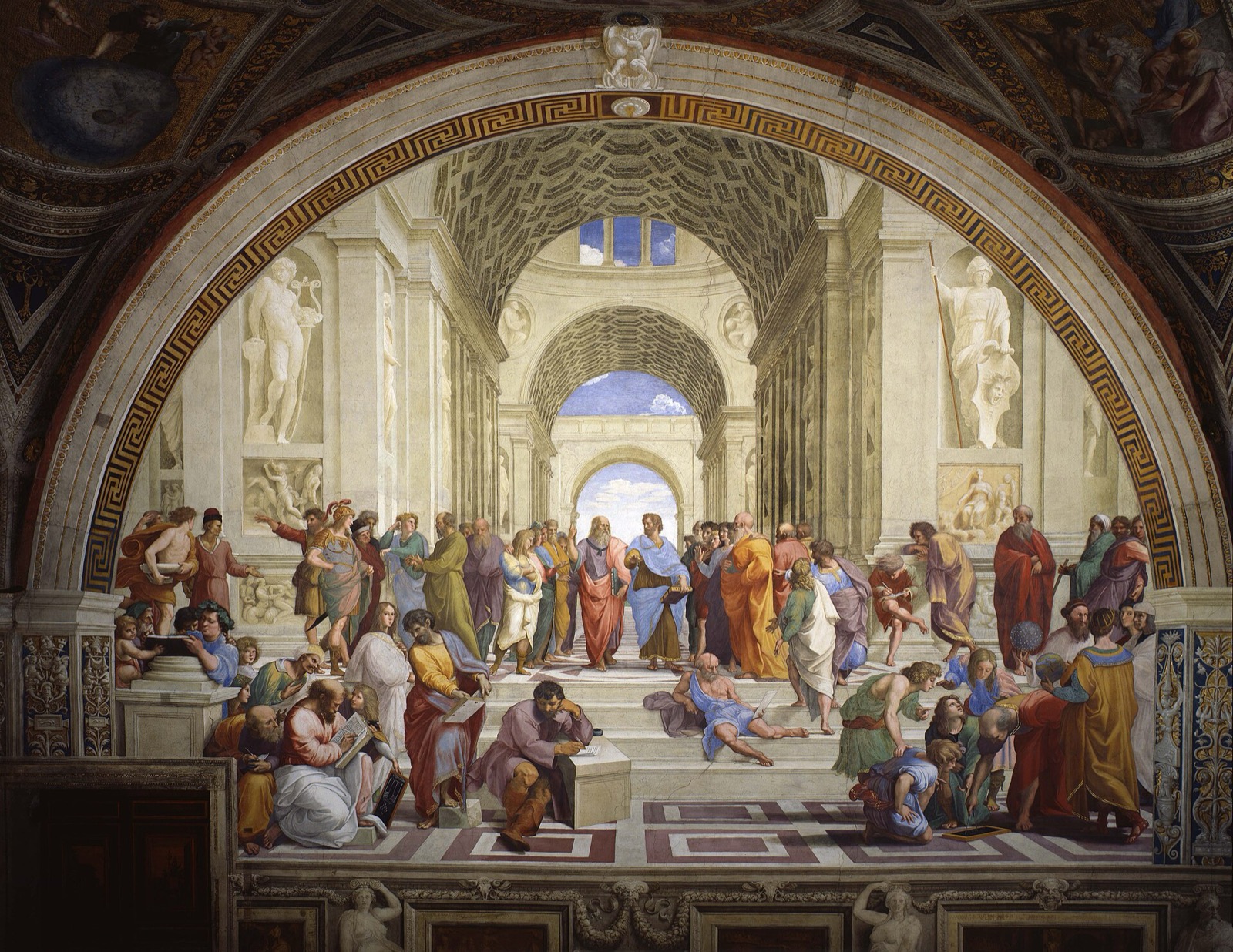
Pythagoras and the tablet
In the lower left of the picture Pythagoras sits writing in a book. In front of him a boy holds a small black tablet. It is easily overlooked, but carefully inscribed:
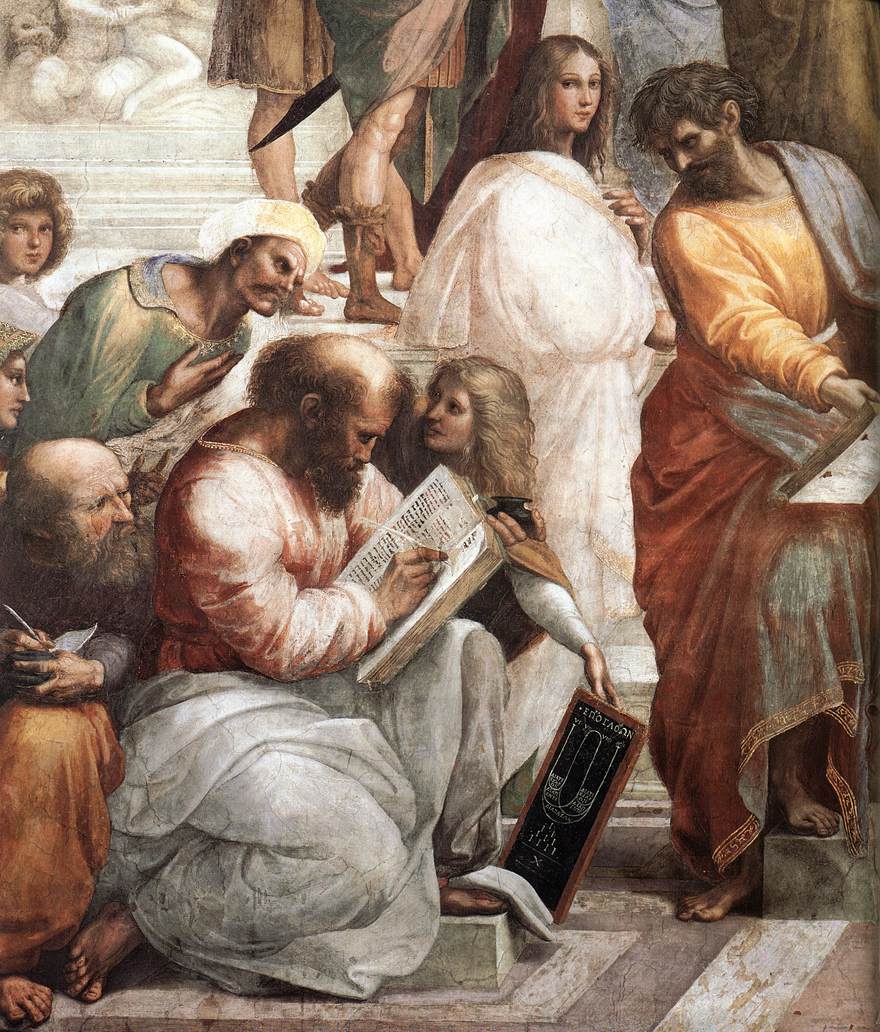
- At the top is the Greek word ΕΠΟΓΔΟΩΝ, epogdoon, “an eighth over”. It means the ratio 9 : 8, the whole tone.
- Below it are the numbers VI, VIII, IX and XII, linked by arcs. These four numbers contain all the basic intervals of Pythagorean music theory: 6 : 12 is the octave, 6 : 9 and 8 : 12 are fifths, 6 : 8 and 9 : 12 fourths, and 8 : 9 is the whole tone.
- At the bottom is a triangle of strokes with the number X beneath it. This is the tetractys with its sum of ten.
So Raphael did not show Pythagoras with the theorem of the right triangle for which he is known today, but with music and the tetractys. In his time, the Renaissance, precisely this counted as the heart of Pythagorean teaching: the insight that harmony rests on ratios of numbers. You can hear how these ratios sound on the page Number and sound.